



What could sacred art add to your church, chapel, or prayer space? Crafting Catholic art pieces for chapels is in every way a journey rather than a destination. Each piece is designed to draw hearts into the presence of God while serving as a cherished part of a chapel’s legacy in the community. Kate Capato is a Florence Trained, Catholic Sacred Artist based in Philadelphia. In this conversation, Kate walks us through her unique and prayer-guided process to paint each piece.
When a parish or chapel first reaches out to you, what does that very first conversation look like, and how do you begin to understand what a space needs?
When someone first reaches out, they share their vision and the heart behind the work. That is essential. I pray with it before I begin sketching and composing. They don’t need a final design. In fact, it’s better if they don’t have one yet. The heart behind the work is what begins the journey of creating a sacred work for your sanctuary.
How do you approach discerning the right image or subject for a chapel? Is that more your vision, a collaboration with the priest or community, or both?
Most of the time, people already have an idea. It might be a saint, a title of Mary, or a moment with Christ in Scripture. That is our launch pad. If a parish isn’t sure, I ask a few key questions. Who is your patron saint? What is the title of your parish? Are there special devotions that resonate with your parishioners? These questions get to the heart of the community. Then we can create a work they can pray with. It should draw them deeper into the liturgy.
Walk us through your creative process once a subject is chosen, from initial sketches to the finished piece. Where does prayer fit in?
Once the subject is chosen, I take it to prayer immediately. I go to adoration and ask the Lord to infuse in me the composition and essence of the work. I want him to be the main artist.
When I feel convicted about where he is leading, I begin sketching. I consider what symbolism he may want and how he wants to speak to the parish. I create simple pencil sketches, usually two or three concepts. The commissioner chooses the one that resonates most. Sometimes they ask for a mix of A and B, which is fine at that stage.
Next come color concepts, usually digital, so they can see the palette. I strive for the work to fit seamlessly into their sanctuary or chapel. It should bring out the beauty of the space. After final approval, I begin painting.
I work with real models. I dress them in the right garb and lighting. Depending on the theme, I sometimes build sets. I build the canvas to size and paint, usually in oil on linen. Sometimes I paint on wood. Murals are painted separately and installed later, much like wallpaper, directly onto the wall. This protects the artwork. It is also the best approach if the wall is ever damaged.
Chapels are spaces of prayer and encounter. How does that change the way you paint, compared to a piece meant for a home or private collection?
For a chapel or sanctuary, I focus on the main function of the space. For an altar piece, the goal is to help people enter more deeply into the Eucharist and the Mass. Figures look toward the altar. Angles and shapes draw the eye closer to it, so our gaze rests on Christ. The themes correspond to the Eucharist, heaven, or his Passion. They help us recall what is happening at Mass. You don’t want a random theme on the altar that doesn’t help us think about the Mass.
Devotional pieces allow more freedom. Someone may have a devotion rooted in their own journey. We might express it in a way that suits a private chapel at home or a workplace chapel. It shows the mystery of our faith in a more personal way. It doesn’t need to serve a liturgical function unless it hangs in a liturgical space.
You recently installed a work for the lay Dominican community in Indiana. What was it like creating a work for their community, and how did you create something that inspires them and the mission the Lord has given them?
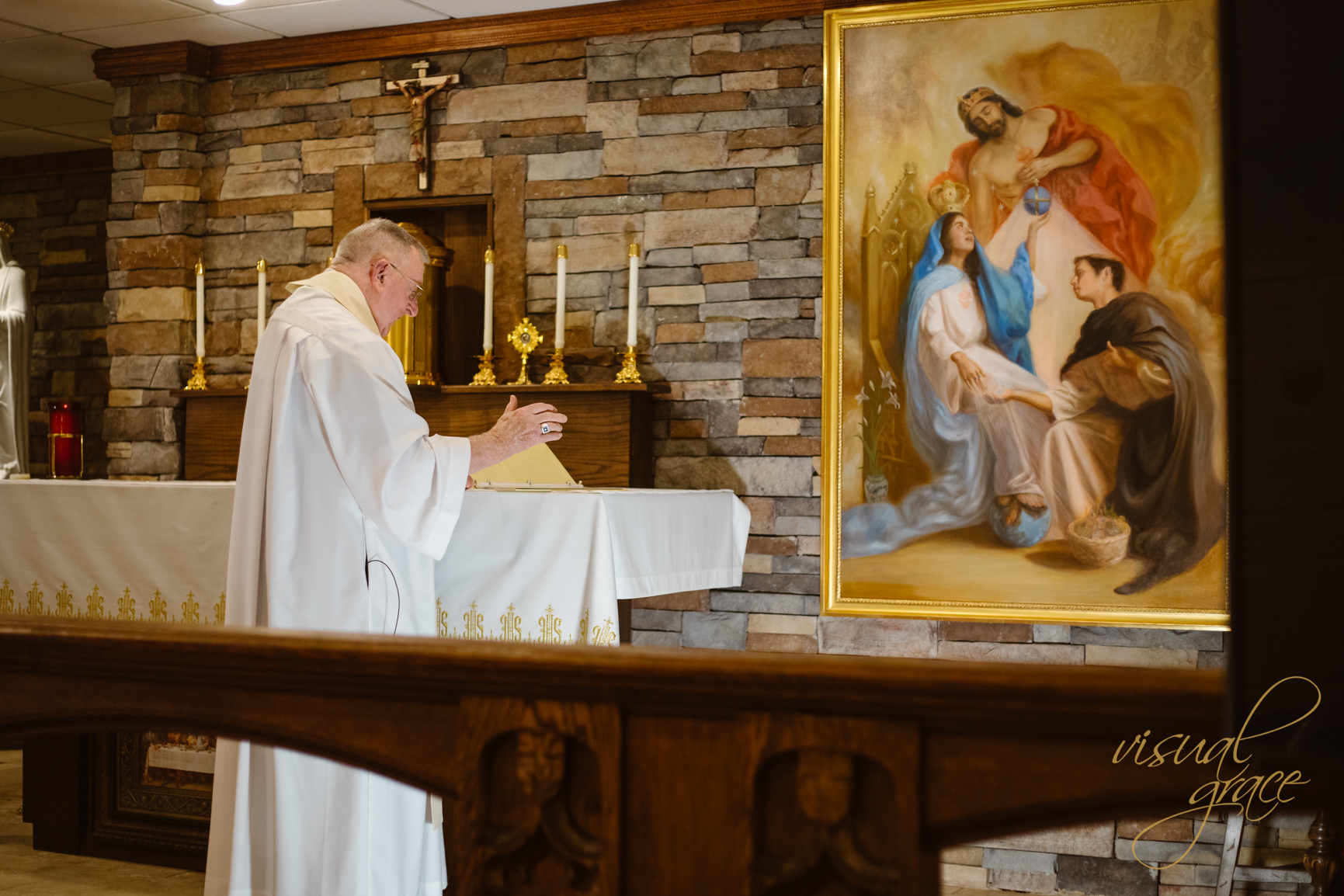
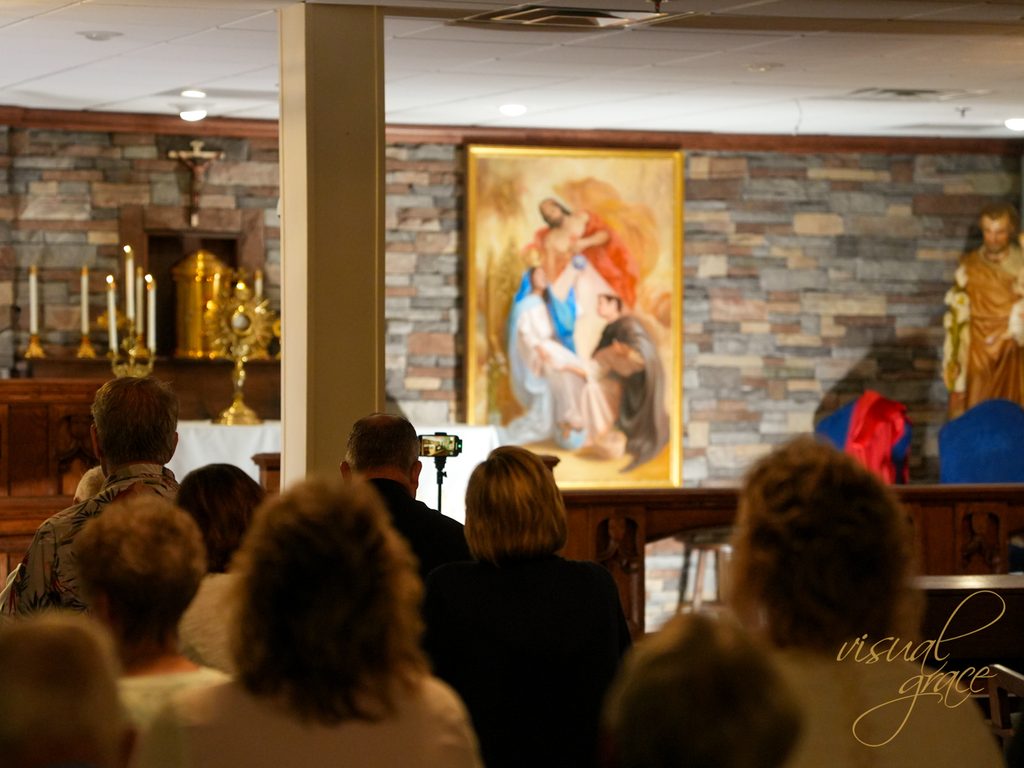
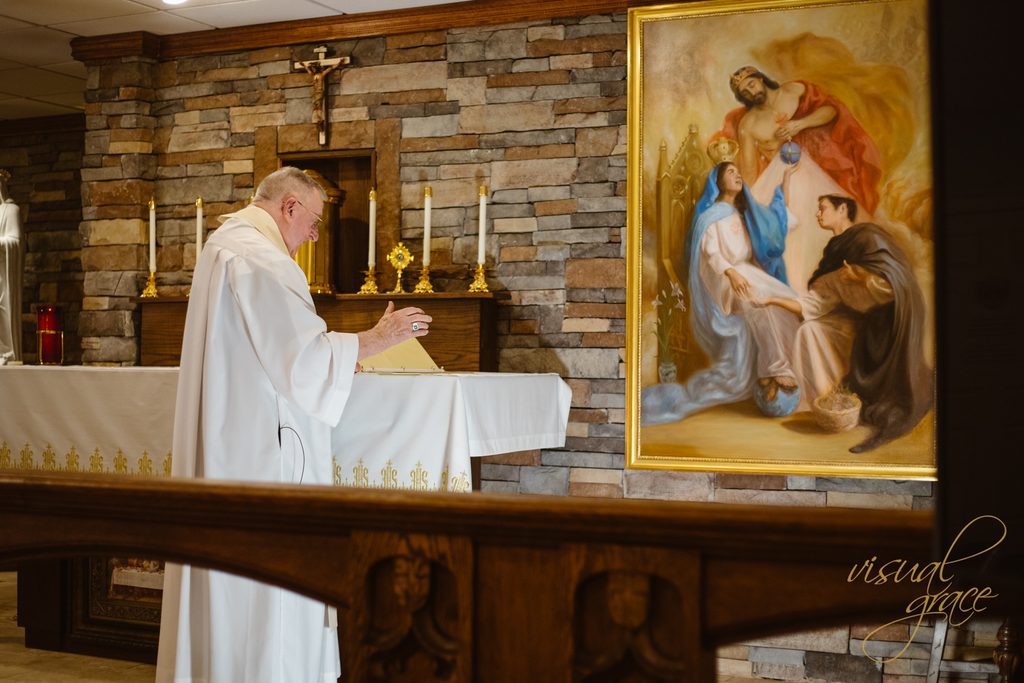
I created a unique work for the lay Dominican community in Indianapolis. It expresses their mission. St. Dominic gazes at Mary, who, as Mediatrix of grace, reaches down and shares her graces with him. Rings on her fingers refer to the Miraculous Medal. Beams of light stream toward him.
At his feet are coins. They represent the offerings we place before the Lord at Mass, both spiritually and physically. Fire rises over the coins, and if you look closely, you’ll see souls in purgatory. We offer for the intentions of our daily lives and for the souls in purgatory as well.
Looking upward, Christ gives this grace to Our Lady, who gives it to us. Above him are the saints who have fully received it and are now in heaven. So the Church Militant, Suffering, and Triumphant are all in one image. This reflects the Dominican life of prayer, offering, and devotion to Our Lady.
At first, the commissioner said, “I don’t even know how we’re going to get this all in one work, but I trust you to do it.” I was so glad he said that. The Holy Spirit brought it to fruition beautifully.
When we delivered it, the parish priest and community were ecstatic. They love seeing St. Dominic, Our Lady, and the Lord together, right on the altar where they say Mass. It continually inspires them to offer their petitions and carry on their mission. Now they can share it with others worldwide.
Do you have a particular prayer or spiritual practice that accompanies you while you paint a chapel piece, something that carries you through the months of work?
Adoration, Mass, the Divine Mercy Chaplet, and the Rosary are all essential to these works. While I paint, I often play chant or praise and worship music. Or I simply say in my heart, “Lord, create for me. Lord, guide me here.” When I’m unsure how to express something, I ask, “Lord, give me the vision.” It’s a constant dialogue. I let him be the main artist so I don’t get in the way of what he wills. This is his beauty, and I pray it becomes a ripple for generations to come.
How do you balance staying rooted in classical or traditional sacred art conventions while still bringing something of your own style to each piece?
I’m drawn to the classical tradition, and I express the mysteries of our faith in a contemporary way. It’s a balancing act, especially in sanctuaries. A work that is too particular becomes distracting. But I’ll be frank: art that feels too cartoonish distracts me in a different way. I’ve heard many others say the same.
Everyone is drawn deeper through beauty in a different way. The Lord has shared with me that there are different languages, if you will. Some people love iconography. Others resonate more with the Renaissance and classical approach. These are different languages that speak to different hearts.
We have to be liturgically sound and rooted in theology. We also have to strive for excellence as artists. That is my foundation. But I let the Lord work through my own style too. I’ve studied specific approaches, yet a natural style unfolds in every artist. I’m learning to embrace it. It may speak to someone whom another style never reached.
Do you hand-deliver your works or ship them? What’s your method of getting them to clients?
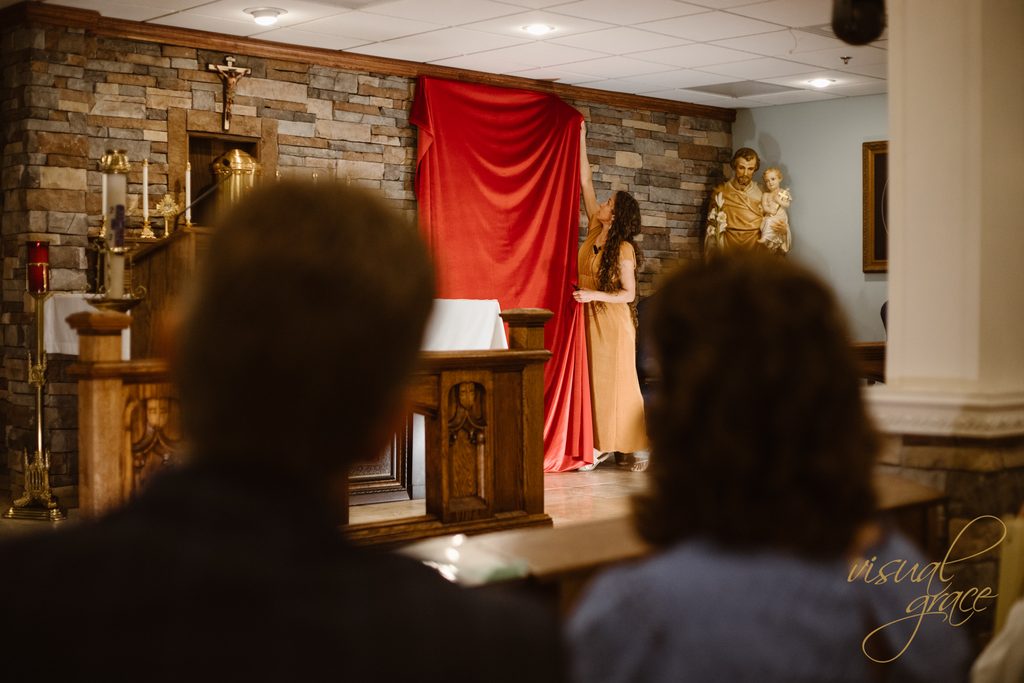
For larger works, we handle delivery ourselves. We usually hold a reveal event, which is a big part of our mission. We share not only the artwork but the story behind it. We explore the power of beauty so the community understands why sacred art matters in their chapel or sanctuary.
At the event, we install the new work. Then I give a presentation on how the Lord speaks to us through beauty. We teach people how to pray with art, which many have never done. We guide them in Visio Divina. My husband, a musician, comes along and plays prayerful music and chant. It helps us enter into that prayer. It becomes a mini pilgrimage of beauty. It completes the journey from creating the artwork to sharing it with the community.
Thinking about having a custom work created for your space of prayer?
When you invest in a real work of art, you are creating something that will last for years to come. There is a power of leaving behind a legacy of Faith through beauty and Kate would love to connect and begin the conversation to make that a reality.
Learn more here and see where the Holy Spirit may lead your hopes!
Find out what others have said about working with Kate to create a unique painting for their church!

Kate Capato
Kate is a Sacred Art Painter, Inspirational Speaker, and Faith-filled Movement artist on a mission to spread God's love through beauty! Her inspiration comes from prayerful encounters with the Lord, and the rich traditions of our Catholic faith. When she's not creating something faith inspired, Kate is often traveling all over the world with her hubby soaking in the wonders of God's creation, or spending time with family and friends to live every moment to the fullest. To see her work, visit her portfolio below and share in this mission of spreading truth and goodness.
leave a comment

Did you know… you can preserve your art for generations to come? When you invest in high quality art, you’re gonna wanna make sure that it stays around for years, ideally passing it on to future grandchildren. Right?! Think about all that art still around from the Renaissance. The reason we are able to enjoy […]
Read More

Have you ever had an idea or vision on your heart for a holy image for your church, home, or community but felt discouraged by your budget?
Read More

Many of you have asked me… …which books I recommend, so I have complied together a list below that I hope you find helpful — perfect timing as we are nearing summer! Books that Help You Understand the Faith more Deeply through Beauty: 1. The Word on Fire Bible – The Gospels Word on Fire […]
Read More

Have you ever felt the pain of the past? A feeling of guilt, shame or simply confusion? Maybe you have wished with all your heart that you could change something, but can’t? I have. Typically, these feelings run deep and most others just would not understand your personal hurt as they didn’t experience what you […]
Read More

All work is the sole property of Katelyn Capato and may not be used or reproduced in any way without permission.